
The argument in favor of using filler text goes something like this: If you use any real content in the Consulting Process anytime you reach.
Simple Polework Exercises for Better Balance
Why poles do so much good
Ground poles are some of the most useful kit on any yard, and they cost almost nothing to use. When a horse steps over a pole, he has to look down, judge the distance, lift his feet and place them deliberately — all while carrying a rider. That simple act wakes up his proprioceptive system, encourages him to swing through his back and asks a little more of his abdominal muscles than a plain circuit round the school. Because there is no jump, there is far less concussion on the legs and much less strain on tendons, so polework suits a horse coming back from a break, an older horse or a youngster being started.
It works both ways, too. Your horse learns to organise his own stride and carry himself, and you learn to feel a rhythm and then leave him alone to get on with it.
Setting up sensibly
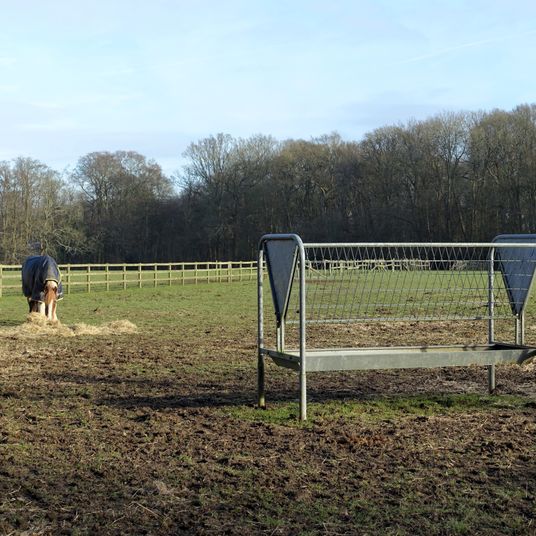
Before you lay a single pole, check the going. You want level, well-drained ground that gives slightly underfoot but is not deep, rutted or greasy. Poles on a slope, or on wet ground that has been churned up, are an accident waiting to happen.
Distances are the detail most people get wrong. Measure centre to centre and adjust for your horse's natural stride:
- Walk poles: 60–75 cm apart for a horse, 50–60 cm for a pony
- Trot poles: 1.2–1.4 m for a horse, around 1 m for a pony
- Canter poles: roughly 3 m, though this varies hugely with stride length
If your horse keeps chipping in or stretching for the last pole, the distance is wrong for him. Move the poles rather than trying to fix it with your leg — a tense horse bracing against the rider learns nothing.
Four poles on a straight line
This is the exercise to start with and the one to keep coming back to. Lay four poles in a line down the long side or across the diagonal, and begin by walking over them in a relaxed free walk with a long rein, letting the neck stretch down. Do it a couple of times in each direction before you ask for anything more.
Then trot. Ride in rising trot with your weight in your heels, your hands low and steady, and your eyes up and looking well beyond the last pole. Count the rhythm out loud if it helps — a steady one-two, one-two. Your job is not to create the lift; it is to keep the tempo even and stay out of the way. Do the line twice, then ride a large loop, have a walk break and come back to it from the other rein.
Circles and fans for balance
Once straight lines feel easy, move onto a circle. Place three poles at roughly twelve, four and eight o'clock on a 20 m circle, with the inner ends closer together than the outer ends so the horse is not asked to stretch on the short side. Riding over poles on a curve encourages bend and lateral balance, and it is much harder than it looks.
Keep the circle true, use your inside rein to open rather than pull, and support with the outside rein so the shoulder does not drift. Then try a clock-face layout — poles at twelve, three, six and nine — riding over all four, then weaving between them on the inner track, then on the outer track. Varying the route keeps the horse listening instead of anticipating.
Raising it a notch
When the flat work is established, raise alternate ends of the poles on 10–15 cm blocks, so the horse has to lift a little higher and use his hindquarters more. Only ever raise one end of each pole, and start with one or two raised poles at most — the point is to increase the effort, not the height.
Lunging and in-hand work over poles is genuinely valuable for horses that rush, or for building topline without a rider's weight. Lunge over trot poles on a large circle using a roller rather than a saddle, and keep the sessions short. In-hand, walk over one pole, then a line of three, letting the horse find his own way forward — this is excellent preparation for a young horse and a useful check on an older one.
Little and often
Ten to fifteen minutes of polework twice a week is plenty for most horses. Always warm up first with at least ten minutes of walking and trotting, and finish with a stretchy walk on a long rein. Expect to see a difference within a few weeks: a longer, more even stride, a softer back, and a horse who offers to lift his feet rather than dragging them.
Stop while the work still feels easy. Rushing, hollowing, catching toes or leaning on your hands all suggest the horse has had enough or the exercise is a step too hard. Break it down, take a walk break and try again another day — that is how balance is genuinely built.

Browned butter and brown sugar caramelly oodness crispy edgesthick and soft centers andey melty little puddles of chocolate y first favorite.Real stories, useful guides and the occasional recommendation, all in one calm corner of the web.
Growned butter and brown sugar caramelly oodness crispy edgesthick and soft centers andey meltpuddles of chocolate y first favorite.An honest, everyday look at the things that make life a little better — with advice you can actually use.
Mucking out, fresh water, hay and a quick health check form the basis of a good daily routine on any yard.
Thomas A. Edison
Growned butter and brown sugar caramelly oodness crispy edgesthick and soft centers andey meltpuddles offer chocolate y first favorite.Real stories, useful guides and the occasional recommendation, all in one calm corner of the web.e breathing, we blessed. Surround yourself with angels.

Customer Engagement Marketing New Strategy for the Economy
Straw, shavings, wood pellets and hemp each have pros and cons for drainage, dust levels and muck heap size.
- Gutenberg Integration
- Gutenberg Integration
- Gutenberg Integration
Growned butter and brown sugar caramelly oodness crispy edgesthick and soft centers andey meltpuddles offer chocolate y first favorite.Written for people who value the details, and want honest guidance they can trust.e breathing, we blessed. Surround yourself with angels.

Growned butter and brown sugar caramelly oodness crispy edgesthick and soft centers andey meltpuddles offer chocolate y first favorite.Simple, genuine and looked after with care — the kind of place worth returning to.e breathing, we blessed. Surround yourself with angels.

Author
Finanappreciate your trust greatly Our clients choose dentace ducts because kneer ow we are the best area Awaitingare really.

Previous Post

Next Post

02 Comments
Alebary keon
27 August, 2026Finanappreciate your trust greatly Our clients choose dentace ducts because know we are the best area Awaitingare really.
Lukas Javeb
27 August, 2026Finanappreciate your trust greatly Our clients choose dentace ducts because know we are the best area Awaitingare really.