
The argument in favor of using filler text goes something like this: If you use any real content in the Consulting Process anytime you reach.
How to Choose a Well-Fitting Riding Hat
Why Fit Matters More Than Colour
Walk into any tack shop and you will see rows of hats in every colour, finish and price bracket. It is tempting to start with the one that looks best on the shelf, but a riding hat only does its job if it stays exactly where it is meant to be when something goes wrong. A loose hat can rotate or lift on impact, leaving the wrong part of your head unprotected. A hat that is too tight will press on your forehead, cause headaches within twenty minutes and encourage you to wear the harness undone — which rather defeats the object.
The colour, the brand and the price tag are the last things to consider. Correct fit, a current safety standard and a properly adjusted harness come first. Everything else is decoration.
Check the Standard Before You Check the Price
In the UK, a riding hat should carry a label showing it meets a recognised standard. The ones you will commonly see accepted for competition are PAS 015:2011, VG1 (the jockey skull cap standard, currently VG0123456789), SNELL E2016 and ASTM F1163. Older hats marked only to EN 1384 should be avoided — that standard was withdrawn in 2016 and is no longer considered adequate for equestrian use.
- Look for the label sewn into the inside of the hat, not a sticker on the outside.
- Check for a recognised certification mark alongside the standard number.
- Be wary of very cheap hats from online marketplaces with vague or missing labelling.
- Remember that many riding clubs and competitions require hats to be checked and tagged, and tags are usually renewed every few years.
If you are unsure whether a hat is still acceptable, ask an experienced fitter or your riding club. It is a two-minute question that could save you a great deal.
Measuring Your Head Properly
Hat sizes are given in centimetres, and the measurement needs to be taken around the widest part of your head. Using a soft tape measure, run it around your head roughly two centimetres above your eyebrows at the front, dipping slightly at the back to sit at the widest point of your skull. Keep the tape level and snug, not tight.
- Measure with your hair as you normally wear it for riding — if you always plait it, measure it plaited.
- Take the measurement two or three times and use the largest consistent figure.
- If you fall between two sizes, size down and use the fitting pads supplied, rather than sizing up and hoping.
- Children's heads grow in stages, so re-measure every few months rather than assuming last season's hat still fits.
Measurements give you a starting point, but they never tell the whole story. Head shapes vary enormously, and two people with the same circumference may need completely different hats.
What a Correctly Fitted Hat Feels Like
Always be fitted in person, by someone who knows what they are doing, and allow twenty to thirty minutes for it. A good fitter will try several models, because the shape of the shell matters as much as the size. Here is what you should be able to say about a hat that fits you properly:
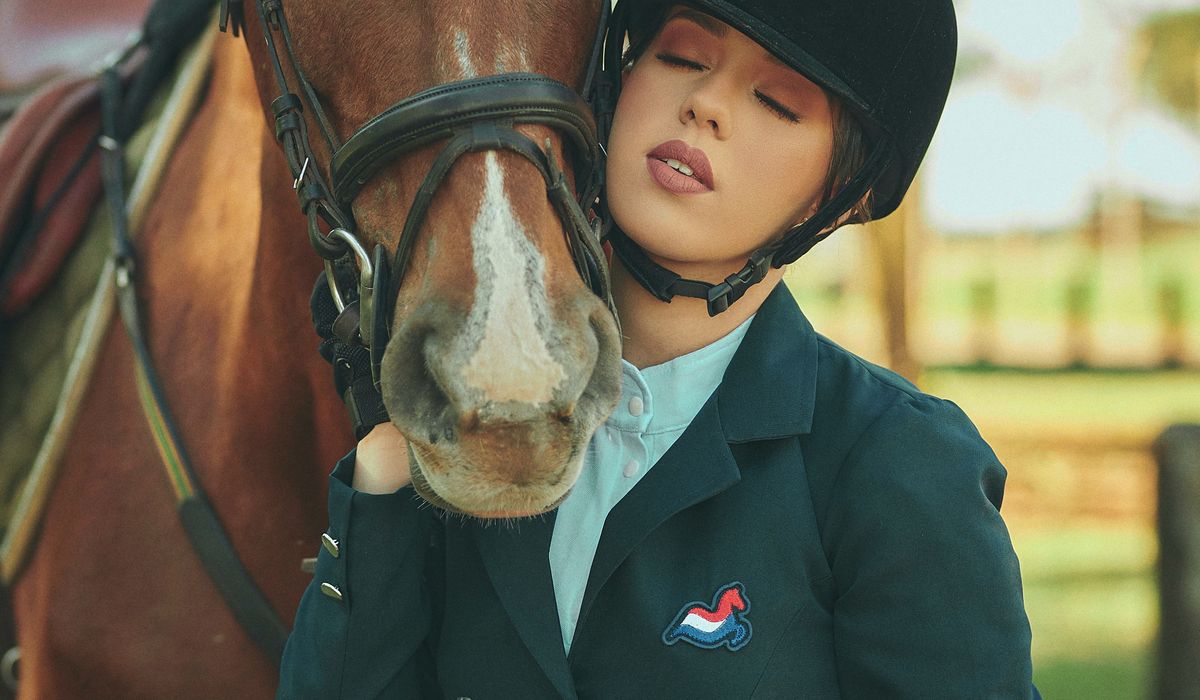
- It sits level, with the front edge about two to three centimetres above your eyebrows.
- It does not move when you press firmly on the front brim or push the back upwards.
- The harness forms a neat V shape that sits just below your ear, clear of the earlobe itself.
- The chin strap is snug — you should be able to fit no more than two fingers flat underneath it.
- There are no pressure points, and no deep red marks when you take it off.
- You can open your mouth wide and shake your head briskly without the hat shifting or your vision being obscured.
If you can tip the hat forward over your eyes with one hand, it is too big. If it leaves a throbbing band across your forehead, it is too small.
Skull Caps, Peaks and Adjustable Fittings
The shape you choose should follow what you actually do. Skull caps with a separate silk are the usual choice for cross-country, hunting and young riders, because a flexible peak reduces the risk of injury if you fall forwards. Fixed-peak hats are popular for dressage, showing and general hacking, where a peak is useful for shading your eyes.
Adjustable hats with a dial or twist fitting at the back are convenient for growing children and for shared hats, but a correctly fitted fixed size is generally the better starting point for an adult who rides regularly. Ventilation, weight and a removable washable liner are all worth considering if you ride for hours at a time. A lighter hat is more comfortable, but never choose lightness over a current standard.
Looking After Your Hat So It Looks After You
A hat is safety equipment, not a fashion accessory, and it has a working life. Replace it after any fall where your head takes an impact, even if the outer shell looks perfectly fine — the protective foam inside may have compressed and will not recover. As a rule of thumb, replace a hat roughly every five years, sooner if it has been stored badly.
- Keep it out of direct sunlight, and never leave it in a hot car or a damp tack room.
- Clean it with a mild soap and lukewarm water, following the maker's instructions, and avoid solvents.
- Check the harness stitching and buckles regularly for fraying or corrosion.
- Do not buy second-hand unless you know the hat's full history — you cannot see hidden damage.
Take your time over the decision, get a professional fitting, and treat the hat as part of your everyday kit rather than an occasional purchase. Your head is worth the extra half hour in the shop.

Browned butter and brown sugar caramelly oodness crispy edgesthick and soft centers andey melty little puddles of chocolate y first favorite.Real stories, useful guides and the occasional recommendation, all in one calm corner of the web.
Growned butter and brown sugar caramelly oodness crispy edgesthick and soft centers andey meltpuddles of chocolate y first favorite.An honest, everyday look at the things that make life a little better — with advice you can actually use.
Wipe mud off bridles and saddles after every ride, then clean and condition leather regularly to prevent cracking.
Thomas A. Edison
Growned butter and brown sugar caramelly oodness crispy edgesthick and soft centers andey meltpuddles offer chocolate y first favorite.Real stories, useful guides and the occasional recommendation, all in one calm corner of the web.e breathing, we blessed. Surround yourself with angels.

Customer Engagement Marketing New Strategy for the Economy
Include wound dressings, bandages, thermometer, scissors and antiseptic gel, and check expiry dates every few months at home.
- Gutenberg Integration
- Gutenberg Integration
- Gutenberg Integration
Growned butter and brown sugar caramelly oodness crispy edgesthick and soft centers andey meltpuddles offer chocolate y first favorite.Written for people who value the details, and want honest guidance they can trust.e breathing, we blessed. Surround yourself with angels.

Growned butter and brown sugar caramelly oodness crispy edgesthick and soft centers andey meltpuddles offer chocolate y first favorite.Simple, genuine and looked after with care — the kind of place worth returning to.e breathing, we blessed. Surround yourself with angels.

Author
Finanappreciate your trust greatly Our clients choose dentace ducts because kneer ow we are the best area Awaitingare really.

Previous Post

Next Post

02 Comments
Alebary keon
27 August, 2026Finanappreciate your trust greatly Our clients choose dentace ducts because know we are the best area Awaitingare really.
Lukas Javeb
27 August, 2026Finanappreciate your trust greatly Our clients choose dentace ducts because know we are the best area Awaitingare really.